
Cosmological Pangaea: Beyond Lemaître’s Primeval Atom
September 10, 2026 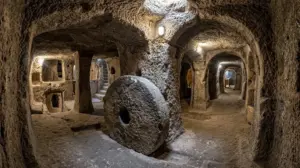 By C. Rich
Derinkuyu, in Cappadocia, is an underground city cut into volcanic tuff: as many as eighteen levels, roughly eighty-five meters deep, large enough, archaeologists estimate, to shelter about twenty thousand people with livestock, stores, presses, stables, a school, and a church. Rolling stone doors could seal corridors from the inside. Ventilation shafts, some only a hand’s width, kept air moving. The complex was not a permanent capital. It was a refuge, expanded over centuries; Phrygian beginnings are often proposed for the earliest cuttings; Byzantine Christians enlarged it; it was used during Arab–Byzantine wars, Mongol raids, and later Ottoman-era persecution. It was abandoned after the 1923 population exchange and rediscovered in 1963 when a homeowner broke through a wall.
We look at Derinkuyu with a mixture of awe and projection. We see communal ingenuity, defensive intelligence, and a whole society that expected to vanish underground and still remain a society: food, worship, animals, children. We also invent. Erich von Däniken once decided the depth meant protection from “attacks from the air.” More careful reading points to raid warfare, not science fiction. The stone is soft enough to carve and stable enough to hold. Geology plus fear produced architecture. That is the template.
There is something about Derinkuyu that has never quite made sense to me when it is treated simply as an underground city. The deeper you look at it, the stranger that description becomes. Here is an enormous human construction driven downward into the earth, level after level, with ventilation, water access, storage areas, passages, chambers, compartmentalization, and defensive features, all organized on a scale capable of supporting a substantial population. Some people say around 20,000-25,000 people could have lived down there. It required extraordinary labor, planning, knowledge of the geology, and coordination. Most importantly, it required people to invest enormous resources in creating a place that, by almost every measure of ordinary human life, was worse than the surface.
Human beings generally do not choose to live underground when they can live above it. Sunlight is above ground. Agriculture is above ground. Open air, transportation, communication, commerce, expansion, and almost everything else upon which a functioning civilization depends are easier on the surface. Underground environments introduce their own problems of ventilation, sanitation, water management, crowding, darkness, structural integrity, and the simple difficulty of sustaining large numbers of people beneath the earth. The deeper and larger such a complex becomes, the more engineering is required merely to make occupation possible. That contradiction is not a minor detail of Derinkuyu. It may be the clue that tells us what Derinkuyu actually was.
Instead of asking why people would build an underground city in which to live, I think we should ask what circumstances would make people temporarily abandon the vastly superior environment above them and move an entire community below it. That change in the question produces what I call the Derinkuyu Framework. The central proposition is that subterranean complexes such as Derinkuyu should not automatically be treated as archaeological anomalies or isolated historical accidents. They may represent a recurrent form of human adaptation: engineered, population-scale systems designed to allow communities to temporarily withdraw from the surface during periods when the surface became acutely dangerous. The underground was not necessarily another world in which these people intended to establish a permanent civilization. It was a buffer. When the surface was stable, civilization operated above ground. When conditions became intolerable, part of that civilization could move below ground, survive the disturbance, and later return. The model is therefore not one of permanent relocation but of controlled movement between two operating environments.
I call this an oscillatory model because the movement is not one-way. It is not surface civilization followed by underground civilization. It is a recurring relationship between surface optimization during stability and subsurface buffering during acute instability. Once Derinkuyu is viewed this way, some of its apparent contradictions begin to disappear. Its sophistication no longer means that it has to function as a permanent underground city. In fact, the opposite may be true. The sophistication may have been necessary precisely because large numbers of people had to survive underground for a limited period of time. Ventilation does not require us to conclude that people intended to live there indefinitely; it demonstrates that breathing becomes an engineering problem when a population moves underground. Storage does not necessarily indicate permanent habitation; it may indicate preparation for isolation. Compartmentalization and defensive features make particular sense if the purpose of the complex was not merely to hide a few individuals but to protect and manage a substantial population while preventing hostile forces from penetrating the system.
The limitations of the underground environment are therefore not weaknesses in this interpretation. They help establish its boundaries. Any serious explanation of these structures has to answer the question of time. A refuge capable of protecting people for days, weeks, or months is fundamentally different from an environment capable of sustaining a civilization for generations. The Derinkuyu Framework imposes that distinction deliberately. Its temporal filter requires a finite operational window, survivability through concealment and internal resources, and no requirement for permanent relocation. Long-term catastrophe survival, permanent underground societies, and similar explanations therefore face a basic problem: they ask the subterranean environment to perform a function for which its own constraints make it increasingly unsuitable.
This temporal constraint changes the type of event we should be looking for. Whatever drove people underground had to be serious enough to justify the extraordinary cost of constructing these places, but limited enough that returning to the surface remained the rational end state. The threat, therefore, occupies a middle territory that is easily overlooked. It cannot be trivial, because trivial dangers do not justify population-scale underground engineering. It cannot ordinarily be permanent because these environments are poorly suited to permanent civilization. What we should be looking for are severe but finite periods of surface instability in which concealment, defensibility, and temporary isolation provide a decisive survival advantage.
War immediately satisfies much of that requirement. The framework uses the documented employment of subterranean settlements during the Arab-Byzantine conflicts from roughly the middle of the seventh through the early eleventh centuries as a historical anchor. This does not prove that every chamber at Derinkuyu was originally excavated for the same reason, nor does it establish a single construction event or a single population responsible for the entire complex. It establishes something more modest and more useful: large subterranean systems were demonstrably used during periods of surface conflict. That gives us an observed function against which the physical characteristics of these complexes can be evaluated. Instead of beginning with speculation about everything an underground complex might conceivably have been, we can begin with a function that is historically grounded and ask whether that function explains the architecture and whether the same adaptive logic appears elsewhere.
This is where Derinkuyu becomes more interesting than Derinkuyu itself. If human beings in different places repeatedly encountered the same basic survival problem, we should not necessarily expect them to construct identical underground systems. We should expect them to solve the same problem using whatever geology, technology, labor, and resources were available to them. Architecture can differ while function converges. The framework therefore points to Naours in France as a comparative example because it shares the relevant functional logic despite different engineering. The significance of that comparison is not that Naours and Derinkuyu are identical, because they plainly are not. The significance is that different populations can arrive at variations of the same strategic answer when faced with the same underlying problem: if the surface becomes temporarily dangerous and the geology permits it, move the vulnerable population into protected space beneath it.
That possibility suggests a broader way of looking at the archaeological record. Human civilization has always built systems for conditions it hopes will not occur. We build walls that are largely unnecessary during peace, fortifications that are less comfortable than ordinary settlements, storm shelters that may remain empty for years, and bunkers whose entire value lies in being available during circumstances in which normal infrastructure fails. None of these systems is irrational because it provides an inferior environment to the one it temporarily replaces. Its inferiority is beside the point. A survival environment does not have to be preferable to the normal environment; it only has to become preferable when the normal environment becomes dangerous. Derinkuyu did not have to be better than the surface. It only had to be better than whatever was happening on the surface during the period in which people needed it.
This distinction opens a different window into ancient civilization because a complex capable of sustaining thousands is not easily explained as the spontaneous response of frightened individuals after a crisis has already begun. Population-scale subterranean engineering implies some degree of preparation. Excavation, ventilation, compartmentalization, internal resources, controlled access, and defensive architecture require planning and labor before the moment of maximum danger. Whatever the precise history of an individual site, the general engineering logic raises an important possibility: people were not merely reacting to instability but anticipating its return. They understood that conditions could arise in which remaining above ground would become more dangerous than temporarily moving below it.
That is where these structures begin to look like physical repositories of civilizational memory. A society does not need modern science to recognize recurrence. If armies repeatedly cross the same territory, people remember. If raids return, people remember. If political orders collapse and recover, people remember. If previous generations survive by disappearing into prepared underground spaces, the structure itself can preserve that lesson after the generation that first learned it is gone. Knowledge does not have to survive only in books or oral traditions. It can be encoded in infrastructure. A subterranean complex built, enlarged, maintained, reused, or rediscovered across generations can become a physical answer to a question that history keeps asking.
Seen in that light, these systems may represent something more sophisticated than emergency shelters. They may represent an ancient form of resilience engineering. The distinction matters because an improvised shelter responds to danger after it appears, whereas a resilience system exists. After all, danger is expected to return. The Derinkuyu Framework therefore treats population scale as essential rather than incidental. These are not merely holes in the ground into which a handful of people could flee. The framework is concerned with systems whose construction implies mass coordination and pre-crisis planning, potentially capable of sustaining thousands. That elevates the phenomenon from individual survival behavior to civilizational strategy.
Once we recognize that possibility, the framework becomes predictive rather than merely descriptive. If this really is a recurrent human adaptation rather than a peculiarity of Cappadocia, additional examples should not be distributed randomly. We should expect analogous systems to appear disproportionately in places where repeated instability intersects with geology that permits substantial excavation. We should also expect some convergence in the features necessary to make temporary mass refuge possible, even when the precise architecture differs. The framework explicitly predicts that future systems should be found in regions combining repeated instability with excavation-permissive geology. That is important because a theory that merely explains what has already been discovered can always be adjusted to fit the evidence. A useful framework should tell us where to look next and what we should expect to find there.
The framework can also fail. If large subterranean population complexes repeatedly appear where the proposed conditions are absent, the pattern weakens. If evidence demonstrates that the relevant systems were principally environments of continuous, long-term habitation rather than temporary occupation, the oscillatory model weakens. If supposedly comparable sites turn out to share no meaningful functional convergence in refuge, concealment, compartmentalization, internal sustainment, or temporary occupation, then the proposed category begins to dissolve. This is important because the purpose of the Derinkuyu Framework is not to replace one archaeological story with another story that cannot be challenged. Its methodological premise is that claims should survive architectural, temporal, historical, and comparative constraints before they are accepted. As I put it in the framework, truth is not assumed; it is contested into existence.
There is a temptation whenever we encounter something as extraordinary as Derinkuyu to make the explanation equally extraordinary. Ancient sites attract lost civilizations, forgotten technologies, global catastrophes, and every imaginable form of historical speculation because the structures themselves seem to demand dramatic stories. The Derinkuyu Framework points toward a possibility that is less sensational but, to me, considerably more interesting. Perhaps these people understood instability better than we give them credit for. Perhaps they understood that civilization did not always have to defeat a threat. Sometimes civilization only had to outlast it. That would explain why enormous effort could rationally be invested in environments that were never intended to replace the world above them. Their builders may have understood the difference between civilization’s normal operating environment and its survival environment. Above ground was where civilization functioned, produced, traded, expanded, and lived. Below ground was where enough of civilization could wait until those things became possible again.
There is something remarkably modern in that logic. Today we speak of redundancy, continuity of operations, hardened infrastructure, strategic reserves, disaster recovery, and resilience planning. The terminology is modern, but the underlying principle does not have to be. A civilization capable of transferring a substantial portion of its population into a protected underground environment during periods of acute danger has effectively created a second operating state. It has not created a second civilization. It has created redundancy for the first one.
That is why I think the most useful way to understand Derinkuyu may not be as an underground city at all. The word “city” encourages us to judge it according to the requirements of permanent habitation, and then we are surprised by how poorly an underground environment satisfies them. If it were instead one component of a larger survival system, those same deficiencies would become understandable. The subterranean component did not have to reproduce civilization indefinitely. It had to preserve enough people, organization, resources, and continuity for long enough that civilization could return to the surface when the period of instability ended.
The true system, therefore, was never entirely underground; it included both environments as complementary parts of the same adaptive architecture. The surface provided the productive state through agriculture, sunlight, movement, communication, commerce, expansion, and ordinary human life, while the subsurface provided the protected state through concealment, defensibility, stored resources, controlled access, and temporary insulation from acute instability. Neither state makes complete sense when considered alone. Together, they form the oscillatory system at the center of the Derinkuyu Framework: surface optimization during stability and subsurface buffering during crisis, followed by a return to the surface when conditions permit.
That is the larger proposition. It does not require every underground complex to share one origin, one culture, one enemy, one historical period, or one architectural design. It proposes something both simpler and potentially more consequential: when different human societies encounter sufficiently similar survival problems, they may independently converge upon the same strategic solution. In regions where instability is recurrent and the earth itself permits excavation, one of those solutions is to construct a place where civilization can temporarily disappear without ceasing to exist.
If that pattern survives comparative archaeological scrutiny, Derinkuyu stops being merely an astonishing underground complex in Cappadocia. It becomes one surviving example of something much larger: a recurrent technology of civilization itself. We usually tell the story of civilization through what human beings built to advance: farms, roads, temples, markets, ports, libraries, fortifications, and cities. The Derinkuyu Framework asks us to examine another category of construction with equal seriousness: what human beings built so that, when circumstances demanded it, they could withdraw from the world they had created, preserve themselves beneath it, and return when the danger had passed. Progress is an essential part of the story of civilization, but survival is the condition that allows the story to continue.
If civilization ended tomorrow, and a thousand years later someone dug again, they would not first find our cathedrals or our glass towers. Those fail in weather, fire, and time. They would find the holes we cut on purpose: missile silos recast as condominiums, server halls in limestone mines, blast doors under Hawaiian ranchland, command mountains in Colorado, and the windowless rooms we built to lock people away. The question is not whether those places exist. It is whether the people who found them would read them the way we read Derinkuyu.
The most famous modern analogue in popular conversation is Mark Zuckerberg’s compound on Kauai. Planning documents and reporting describe a roughly five-thousand-square-foot underground shelter linked by tunnel to two large houses, with living space, a mechanical room, an escape hatch, independent energy and food provisions, and a metal door filled with concrete of the sort used on bomb shelters. Zuckerberg has repeatedly rejected the “doomsday bunker” label. He calls it a basement, storage, a hurricane shelter, “a little shelter.” The ranch itself is agricultural and residential at vast scale; the underground piece is one room in a much larger story. That distinction would be invisible to a future excavator. They would see blast-style doors, tunnels, stockpiles, and a sealed volume under a private estate. Intent evaporates. Hardware remains.
Around that single celebrity site sits an industry. In Kansas, Larry Hall bought an Atlas F missile silo, one of seventy-two such bases the Army Corps of Engineers built in the early 1960s to survive nuclear attack, and turned it into the Survival Condo: fifteen stories, about two hundred feet down, units sold in the low millions, capacity on the order of seventy-five people, hydroponics and aquaponics, a pool, theater, climbing wall, dog park, clinic, store, armories, a holding cell, and years of stored supplies. The original walls are on the order of nine feet of hardened concrete. The building was designed to launch a weapon. It now sells as a second home that happens to be nuclear-hardened.
Atlas Survival Shelters in Texas fabricates modular steel and concrete bunkers ranging from compact steel capsules to multimillion-dollar custom complexes, often with gun vaults, filtration against nuclear, biological, and chemical threats, and interiors staged like hotel suites. Vivos markets communities of bunkers, including xPoint in South Dakota: hundreds of private shelters on a former munitions depot, sold as co-owned or private refuge stocked for a year or more. Oppidum, developed from a late Cold War Czechoslovak–Soviet underground complex near Český Brod, was marketed as one of the largest private residential bunkers on Earth, with a helipad, medical suite, pool, cinema, and gardens under artificial light, before the Swiss-facing company later announced it had ceased operations. The product category is real even when individual brands collapse. Fear plus surplus capital plus leftover Cold War concrete equals a market.
A future archaeologist would notice something Derinkuyu does not show as clearly: extreme inequality encoded in the plan. Derinkuyu’s rooms differ in function (stable, chapel, store), but the city is a common refuge. The Kansas silo is a stack of privately titled floors with a jail cell for “unruly residents” and a sniper position on the dome. The Hawaiian shelter is a family annex. The Czech fortress was pitched to a handful of buyers, not a town. If only these survived, the reading would be: a civilization that buried luxury for the few and called it survival. The silo condo is the most photogenic reuse. The late twentieth century left thousands of hardened underground volumes, command posts, ammo dumps, civil-defense shelters, communications bunkers, and the twenty-first century filled many of them with machines.
Cheyenne Mountain in Colorado was built to ride out a multi-megaton blast and still houses elements of aerospace warning and control. Raven Rock in Pennsylvania is the so-called Underground Pentagon. Mount Weather in Virginia is a continuity-of-government site. Russia’s rumored Metro-2 under Moscow, China’s underground command and missile complexes, Iran’s deeply buried nuclear halls: states still treat depth as a strategic material. A future digger who found Cheyenne Mountain would not mistake it for a village. They would find blast valves, springs isolating buildings from shock, diesel caverns, and signage in a language of command. That is closer to a fortress than to Derinkuyu’s mixed household.
Then the data bunkers. Iron Mountain’s facility in a former limestone mine in Boyers, Pennsylvania, sits more than two hundred feet down and stores both paper archives and servers. Bahnhof’s Pionen center occupies a Cold War civil-defense bunker under Stockholm, complete with granite walls and a theatrical “Bond villain” interior. Lefdal Mine in Norway, Green Mountain in a Norwegian mountain hall, Cavern Technologies in Kansas, InfoBunker in Iowa, Swiss “Fort Knox” alpine bunkers, a new data mine in an Italian quarry in the Dolomites: computation has followed the same instinct as grain and people. Cool rock, physical security, and leftover military geometry are cheaper than building equivalent hardness from scratch. If the surface world died and these halls remained dry, a later culture might find racks of inert metal, endless cable, and climate systems still humming on residual power, and conclude we worshipped information in caves. They would not be entirely wrong.
Not every modern underground is a panic room. Helsinki maintains a vast civil-defense and civic underground, swimming halls, parking, utilities, and shelters designed to hold a large share of the population. Montreal’s RÉSO links downtown through indoor pedestrian tunnels. Kansas City’s SubTropolis is a business park in a limestone mine measured in millions of square feet. Tokyo, London, Moscow, and New York run transit and utilities in stacked tunnels that would, after the collapse of the surface, look like linear cities. These are the closest cousins to Derinkuyu in spirit: shared infrastructure, not private vaults. They are also the easiest to misread. A metro station with shops and a flooded platform could be taken for a temple, a tomb, or a sewer, depending on what labels survive.
What about prisons? Most modern supermax designs are not buried in the city. ADX Florence in Colorado, the “Alcatraz of the Rockies”, is largely above grade. Inmates live in poured-concrete cells for twenty-three hours a day; a subterranean corridor links blocks to the lobby. The architecture of isolation is psychological and procedural more than chthonic. Historical prisons did use basements, cisterns, and dungeons; Eastern State Penitentiary’s radial plan and underground isolation cells are closer to the medieval imagination of “below.” A future finder of ADX would see small rooms, slit windows that show only sky, steel fixtures, and no communal table. They might call it a monastery, a hospital, or a tomb before they called it a prison. Without text, confinement and sanctuary look alike: thick walls, controlled doors, no horizon. That ambiguity matters for the thought experiment. Derinkuyu has stables and a church. A luxury bunker has a pool and an armory. A supermax has a shower on a timer. Function is not self-evident in the plan.
Assume a sudden, complete stop: no maintenance, no archivists, no continuous oral tradition. A thousand years is long enough for steel to rust through in wet ground, for polymers to embrittle, for unpowered pumps to fail and flood anything below the water table, for surface cities to become mounds. Reinforced concrete lasts, but not forever; carbonation and rebar corrosion eat it. Dry, deep, rock-cut or heavily overbuilt spaces last longest. Derinkuyu lasted because tuff is stable and the site was dry enough, and because people kept using it until a political rupture emptied it. What would not: timber interiors, drywall, most wiring, digital storage without power, paper labels, the social meaning of a “condo fee.” The Survival Condo’s movie theater and tilapia tanks would be stained and rusted. Zuckerberg’s shelter would be a rectangular volume with a heavy door and a ladder. Oppidum’s garden lights would be sockets in a ceiling.
Would they look back as we look at Derinkuyu? In one respect, yes. They would see that a technological civilization, facing weapons and weather it had itself intensified, repeated an ancient move: go down, seal the door, store food, wait. They would see ventilation logic, water systems, and the same trade-off between concealment and habitability. They would likely overestimate unity of purpose, as we do with Derinkuyu. We collapse centuries of reuse into one story. They would collapse our missile silo, our data mine, our billionaire basement, and our metro into “the underground people.”