Wet Fusion: The Chip, the Brain, and Transhumanism
October 28, 2026
Engineered Universe Hypothesis vs. Simulation Hypothesis via Chain Theory
October 29, 2026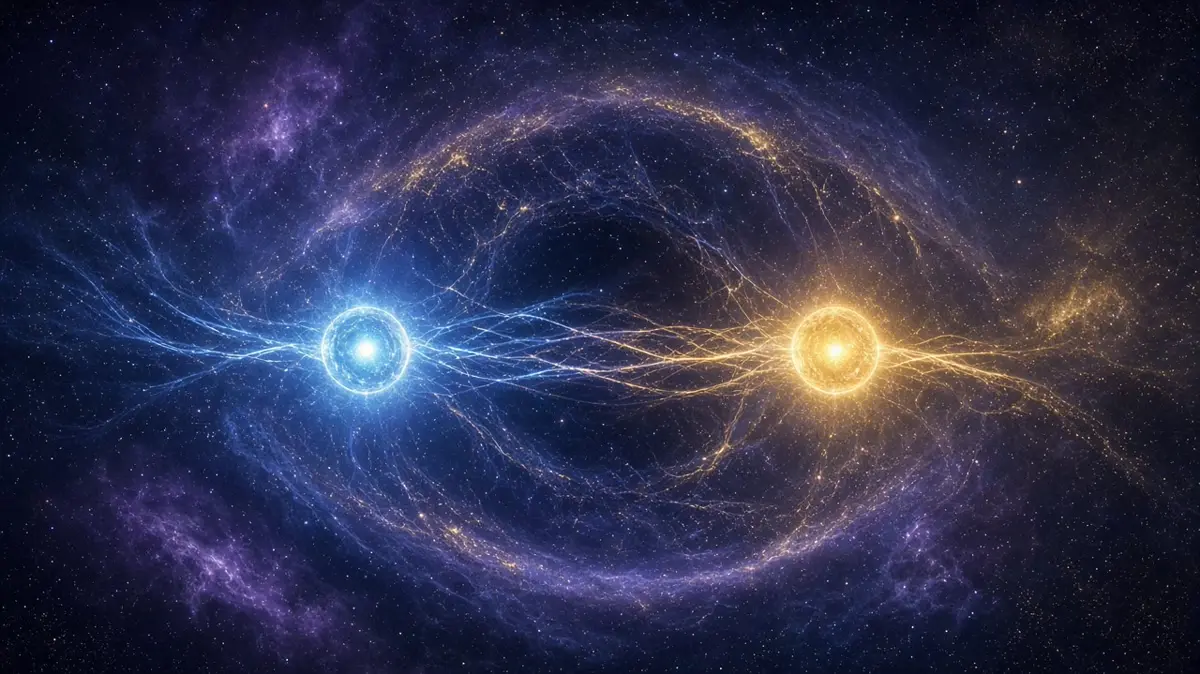
Listen to Free Audio Version Here
What If the Universe Was Observing Itself Before Observers Existed?
By Charles Richard Walker
For as long as human beings have been asking questions about consciousness, we have generally started with something that is already conscious. We examine the human brain, study the nervous systems of animals, investigate how organisms respond to their surroundings, and wonder how electrical activity inside a rather unattractive lump of biological tissue manages to produce everything from the love of a child to an appreciation of Mozart.
Then someone inevitably brings up the hard problem of consciousness, and before long we are discussing philosophical zombies, subjective experience, and whether a machine can ever know what it feels like to be a machine. It is fascinating territory, although I sometimes suspect that consciousness studies have become so enamored with their own vocabulary that we have managed to make one of the most natural things in existence almost impossible for ordinary people to discuss.
I have been approaching the problem from another direction, through my Observer Birth Principle, Nested Observer Windows, and the larger body of work surrounding Cosmological Pangaea and the Functional Consciousness Project. Recently, a new theory proposed by Alexander Wissner-Gross gave me another reason to reconsider the entire question.
What if we have been starting at the wrong end of the story?
What if observation existed before there was anything we would recognize as an observer?
And what if the observer itself is something that the process of observation eventually produces?
That changes the question considerably. Instead of asking when the universe first produced something capable of observing it, we can ask when the universe first developed the relationships through which one part of reality could acquire information about another.
The distinction may sound subtle, but follow it far enough and we could be looking at an ancestry of observation extending all the way back into the quantum foundations of physical reality.
Before There Was Anyone to Look
Imagine a universe with no human beings, no animals, no plants, no microorganisms, and no living things whatsoever. There are no eyes to see the stars, no ears to hear the thunder, and no brains to wonder what any of it means.
Would things still happen?
Of course. Stars could form, particles could interact, and galaxies could develop without anybody standing around to admire the scenery. The universe was apparently getting along just fine for billions of years before we arrived, and I doubt the galaxies were particularly disappointed by our absence.
But suppose we ask a different question. Even without living observers, could one part of the universe acquire information about another part?
That is where things become interesting.
In my Observer Birth Principle, the story begins with distinction. Before anything can be observed, something must be distinguishable from something else. There must be a difference.
We can call the two distinguishable structures A and B.
At first, A and B need not do anything remarkable. They simply represent two distinguishable conditions within reality. The existence of a difference does not mean either structure knows about the other. A mountain is different from an ocean, but neither is necessarily contemplating the other’s existence.
Now imagine that A and B enter into a physical relationship. Something about B affects A, or something about A affects B. A relationship has developed, but even that does not automatically create an observer. Physical interactions happen everywhere.
The next possibility is more important. What if a relationship between A and B becomes accessible through another relationship? What if information about one physical interaction can be carried into another interaction somewhere else within the system?
Now we have something worth investigating.
We have not created a human mind. We have not created consciousness. We have not even necessarily created memory.
But we may have the beginnings of an observational process.
And that leads to the inversion at the heart of this hypothesis: observation may precede the observer.
Enter Chain Theory
In October 2026, theoretical researcher Alexander Wissner-Gross introduced Chain Theory, an ambitious attempt to approach physical reality from a different foundational starting point.
The theory begins with maximally entangled pairs of finite-dimensional quantum systems, some of which participate in networks of shared relationships. Wissner-Gross proposes that these relationships become known through operations called distillations, which take place inside the network itself.
There is no little scientist standing outside the universe with a clipboard, deciding which quantum relationship to inspect. The operations through which relationships become accessible belong to the physical network.
That immediately caught my attention.
To appreciate why, we need to talk briefly about quantum entanglement without turning this into a graduate seminar.
Imagine two quantum particles prepared in an entangled state. Their properties are connected through a shared quantum relationship. When the particles are examined, their measurement results can display correlations that cannot be explained by assigning each particle an ordinary independent collection of predetermined local properties.
The important point for our discussion is that the relationship belongs to the combined system. Looking at either particle by itself does not reveal everything contained in their joint quantum state.
Now consider what happens when relationships of this kind become linked into larger networks.
Chain Theory provides operations through which basis relationships can be transmitted along entangled links. Its mathematical framework also introduces records, byproduct information, and transformations that distinguish meaningful relational quantities from arbitrary choices of description.
In ordinary language, the theory gives us a way to consider how information about one relationship might become accessible through another relationship, without requiring an outside observer to initiate the entire business.
That is precisely the territory I had been pondering.
I began thinking about the earliest possible relationship between A and B. What would it mean for B to look back at A?
Of course, B would not have eyes, a brain, or a tiny quantum-sized face. It would not be sitting there experiencing an existential crisis about its place in the universe. We are discussing a primitive physical relationship, not a microscopic philosopher.
But the question remains. Could the relationship itself develop the conditions under which one part of reality becomes accessible to another?
And could such processes eventually produce the structures that we call observers?
That is when the phrase came to me.
Entanglement is the observer in progress.
The Observer Does Not Have to Come First
There is a peculiar habit in our thinking. We tend to imagine that a thing must exist before the process associated with that thing can begin.
We see a bird flying and naturally associate flight with the bird. But the physical principles that make flight possible existed long before the first bird appeared. Airflow, pressure differences, gravity, and motion did not wait for feathers to be invented.
Likewise, perhaps the physical conditions that make observation possible existed long before anything resembling a recognizable observer developed.
That does not mean every interaction is observation. Such a definition would be so broad that it would explain almost nothing. The useful question is whether physical relationships can make distinctions accessible through other relationships.
Consider a simple analogy.
Imagine two people who have never met, living in separate villages. The villages exist, and the people are distinguishable, but neither knows anything about the other.
Then a messenger travels between them.
Information that was once confined to one place becomes accessible somewhere else. We have established a connection through which something about one relationship can be communicated into another.
Now imagine the messenger disappears and the message is immediately forgotten. Something was communicated, but no enduring knowledge remains.
Suppose instead that the recipient preserves the message. The information becomes a record.
Later, the recipient uses that record to make a decision, changing what happens next.
We have moved from communication to memory, and from memory to consequential action.
The analogy is imperfect because our imaginary people already possess minds. But remove the people and keep the structural relationships, and we begin approaching the idea I want to investigate.
A physical distinction becomes accessible. Some of that information survives. Eventually, the surviving information influences subsequent interactions.
At what point in that unfolding process does something qualify as an observer?
Perhaps the answer lies much earlier than biology.
The Birth of the Observer
My Observer Birth Principle proposes that a functional observer emerges when a persistent structure acquires the ability to register information about another structure, retain that information, and have its subsequent behavior influenced by what was registered.
Those are three important developments, and they need not occur simultaneously.
A physical interaction might transfer information without leaving a persistent record. Another interaction might create a lasting record that never influences anything else. A more sophisticated system could preserve information and use it to alter its future behavior.
That third possibility begins to resemble what we ordinarily mean by an observer, even if the structure possesses no intelligence or conscious experience.
But our latest pondering suggests that these conditions describe the birth of the observer rather than the birth of observation itself.
Primitive observation may begin earlier, when physical relationships first make distinctions accessible within the network.
Repeated relational interactions might eventually develop into stable registration. Some registrations might persist. Some persistent records might influence later events. Over time, these processes could become organized into increasingly elaborate systems capable of maintaining information about both their surroundings and their own previous interactions.
The observer would emerge from that organization.
We should not assume that every stage automatically produces the next. A relationship does not inevitably produce memory, and memory does not automatically produce consciousness. Those transitions may require additional conditions that we have yet to understand.
Nevertheless, the possibility offers a different way of investigating the origin of observers.
Instead of searching for the moment when matter suddenly acquired an entirely new property, we can investigate whether increasingly organized observational relationships developed capacities that were absent from their simpler predecessors.
In that interpretation, an observer is not necessarily a fundamental ingredient of reality.
It is something reality becomes capable of producing.
Can a Quantum Relationship Remember?
This leads to one of the most interesting questions raised by Chain Theory.
If entangled relationships form networks, can those networks retain information about their own development?
Wissner-Gross’s framework contains mathematical objects called Weyl byproducts, or letters, associated with certain distillation operations. It also develops records that remain meaningful under permitted changes in how basis directions are matched across the network.
Those terms sound intimidating, but the underlying question is easy to appreciate.
Imagine constructing two networks from the same starting relationships. In one network, you establish the connections in one sequence. In the other, you use a different sequence.
If both networks eventually become physically identical, there may be no way to determine which history occurred merely by examining their final configurations.
But what if they retain a meaningful difference?
Perhaps some aspect of their relationship structure remains distinguishable. Perhaps a later operation can recover information about which arrangement exists. Perhaps that information changes how another operation behaves.
Then the network has retained something about its own past.

The interesting question is not whether we can force such behavior by inserting an ordinary computer memory into the experiment. We already know how to build memory devices. The question is whether Chain Theory’s own relational operations naturally possess the capacity to establish and preserve these distinctions.
Its mathematics includes a way to distinguish meaningful records from changes that merely reflect our choice of description. Physicists call such changes gauge transformations. In everyday language, they are rather like changing the labels on a map without changing the countryside.
A useful physical record should contain information that cannot be eliminated merely by renaming things.
We have not yet demonstrated a particular short Chain Theory network in which one relationship makes a distinct, gauge-invariant record about an earlier relationship accessible through a subsequent read. The theory supplies relevant operations and mathematical definitions, but that specific demonstration remains an open task.
And I think it is an excellent question to place before other researchers.
Can a network of quantum relationships acquire information about its own formation? Can it preserve that information? Can a subsequent relationship make use of it?
If the answer is yes, we may have discovered a meaningful quantum-relational model of the earliest stages of observation.
If the answer is no, we will have learned something equally useful about what additional structure is required.
Either way, we are investigating the origins of observation without assuming an observer already exists.
The Observer Windows Begin Opening
There is another reason this possibility interests me. It connects with my Nested Observer Windows hypothesis, which explores how observational capacities might develop through successive layers of informational access.
Imagine looking out a window at the world. You can see trees, roads, buildings, and people passing by. But you cannot see everything. The window determines which portions of your surroundings are available to you.
Now imagine opening another window that allows you to examine the first window itself. You begin learning something about the conditions that determine what you can see.
A further window might reveal the mechanisms controlling the second. Additional windows could expose more of the relationships governing the entire observational process.
The central idea is that observers may develop increasingly sophisticated capacities not simply by acquiring more information, but by gaining access to the mechanisms through which information becomes available.
An elementary system might register a difference in its surroundings. A more sophisticated system might remember earlier registrations. Another might compare current information with previous records, identify discrepancies, and alter its behavior accordingly.
Eventually, a system might begin monitoring its own observational processes. It could recognize that certain information is missing, that its internal representations are unreliable, or that its observational architecture imposes limitations on what it can distinguish.
Artificial intelligence provides an obvious setting for exploring these possibilities. We are already building systems that evaluate their own responses, preserve information across interactions, monitor aspects of their operation, and modify their approaches when particular strategies fail.
None of that automatically establishes consciousness. A machine can possess sophisticated self-monitoring capacities without necessarily experiencing anything.
But it demonstrates how observational architectures can become increasingly elaborate.
And if our present hypothesis is correct, the ancestry of those architectures may begin much farther back than neurons or computers.
The first observational window may not have resembled a window at all. It may have been a physical relationship through which one distinction became accessible to another.
The complicated business of remembering yesterday, wondering about tomorrow, and contemplating our own existence could represent much later developments in the same unfolding process.
A Process That Has Never Finished
This is where the idea begins to acquire an even larger philosophical significance.
We naturally think of consciousness as something that emerged and then reached its present form in human beings. We speak as though evolution eventually produced us, we developed intelligence, and the great story of observation finally reached its destination.
Humanity has always been rather fond of placing itself at the end of important stories.
But why should observation stop developing with us?
If observation is an unfolding process, biological consciousness may represent one development within that process rather than its completion.
Human memory, language, scientific reasoning, and self-awareness dramatically expanded the ways in which reality could be investigated and represented. Our instruments extended the reach of our senses. Telescopes revealed galaxies, microscopes revealed microorganisms, and computers allowed us to study relationships far beyond the capacities of unaided human calculation.
Now artificial intelligence is expanding those capacities again.
Future artificial systems may possess observational windows unlike anything biology has produced. They may integrate enormous quantities of information, examine aspects of their own internal architecture, and develop capacities for representing physical reality that human minds struggle even to imagine.
There is no established reason to declare that this will necessarily result in conscious machines. Nor can we assume that more intelligence automatically produces greater awareness.
But the larger possibility remains.
Observation may continue becoming more elaborate through increasingly sophisticated relationships, memory structures, and systems of information processing.
The observer is not necessarily the end of the process. It may be one of the structures the process produces along the way.
This brings to mind another idea from my Cosmological Pangaea research: the Garden.
In that framework, the Garden is the pre-object derivational domain or process containing the conditions capable of producing the Pangaea object. The Garden and Pangaea are distinct. One describes the generative conditions; the other is the object produced.
The parallel here is conceptual rather than a demonstrated mathematical identity.
The process of observation may precede the observer in much the same way that a generative process can precede the organized structure arising from it.
And perhaps the continuing development of observation could someday produce macroscopic organizations of memory and intelligence far beyond any individual observer. In my broader pondering, I have considered possibilities such as a Cosmic Library, an immense accumulation and organization of information through which the history of observation might become something entirely new.
I am not claiming that the universe is destined to construct such a library, or that quantum entanglement somehow predicts its existence. I am simply recognizing that if observation is a continuing process, there is no compelling reason to assume its ultimate products must resemble us.
We may be participants in an unfolding story whose final scale we cannot yet conceive.
What About the Strange Windows of Human Experience?
There is another speculative connection worth mentioning because it illustrates how broadly the question of observational architecture can be explored.
People reporting experiences with N,N-DMT frequently describe extraordinary geometries, intricate patterns, elaborate spaces, and apparent encounters with entities. Reports involving 5-MeO-DMT often emphasize something quite different: the dissolution of ordinary selfhood, the disappearance of familiar boundaries, and experiences in which the distinction between observer and observed seems radically altered.
These descriptions have sometimes reminded me of different regions of the developmental process we are contemplating.
The dissolution of ordinary distinctions reported with 5-MeO-DMT invites an analogy with a primordial condition before elaborate observational organization. The intricate geometries and apparent experiential worlds reported with N,N-DMT invite comparison with later stages in which distinctions have developed into spatial structures and increasingly elaborate windows of experience.
I have even wondered whether such experiences might resemble a kind of journey backward through the architecture of observation.
That is High-end Pondering, not a scientific conclusion. There is no established evidence that these substances transport consciousness into the physical past, provide access to the Garden, or reveal the actual primordial history of the universe. Changes in present-day brain activity can produce profound alterations in the organization of experience without revealing an independently existing ancient reality.
Still, the phenomenology raises a useful question. If the mind constructs its experienced world through layers of informational organization, could altered states help researchers understand how those layers develop, interact, or temporarily dissolve?
That question belongs to a later investigation. It is connected to the broader hypothesis, but it need not be answered before we investigate the quantum ancestry of primitive observation.
The Question I Am Putting Before the World
I have no intention of pretending that this paper solves consciousness. I suspect anyone claiming to have settled the entire matter in one afternoon deserves at least a little skepticism, particularly if they are also selling a subscription.
What I believe we have identified is a different starting point, together with some specific questions that other researchers can investigate.
Can one quantum relationship make information about another relationship accessible from within the physical network itself?
Can those relationships preserve meaningful distinctions about their earlier interactions?
Can preserved information influence subsequent operations, allowing a network to develop something resembling consequential memory?
Can repeated processes of relational accessibility eventually become self-referential, allowing a system to register aspects of its own previous registrations?
And, most importantly, what additional conditions are required before an unfolding process of physical observation produces something we would reasonably call an observer?
Wissner-Gross’s Chain Theory offers a new mathematical setting in which to explore some of those questions. My Observer Birth Principle proposes criteria for identifying the emergence of persistent functional observers. Nested Observer Windows explores how observational capacities might continue developing after that threshold.
These frameworks need not be mathematically identical for the investigation to be worthwhile. Each may contribute something different, and the relationship between them may ultimately prove more limited than the conceptual parallels suggest.
The opportunity is to discover what actually follows from the underlying relationships.
I would particularly welcome mathematicians, quantum-information researchers, theoretical physicists, cognitive scientists, consciousness researchers, and independent thinkers willing to investigate the proposal from different directions.
The invitation is not to declare entanglement conscious or to invent a miniature mind inside every particle. It is to examine whether the physical ancestry of observation can be reconstructed from relationships that originally required no observer at all.
If the hypothesis succeeds, it could illuminate a developmental connection between the quantum structure of physical relationships and the later emergence of systems capable of observation.
If it fails, we may discover that primitive relational access is insufficient and that some additional organizational principle is necessary.
Both outcomes would advance the discussion.
The Universe Looking Back at Itself
There is something rather extraordinary about our present circumstances.
We live in a universe that has produced creatures capable of reconstructing its own history. We can observe radiation from the early cosmos, examine the behavior of quantum particles, build machines that analyze their own calculations, and contemplate whether the physical relationships underlying reality might contain the ancestry of the very capacity through which we investigate them.
The universe has produced systems that can look back upon the processes from which they emerged.
But perhaps the looking back began long before the first human eye opened.
Perhaps it began when one physical relationship made information about another accessible elsewhere within reality. Perhaps the persistence of such relationships eventually permitted memory. Perhaps the organization of memory made possible progressively richer forms of observation, until some structures became capable of recognizing their own observational activity.
If so, the first observer was not the beginning of observation. It was an achievement of a process that had already been unfolding.
That is the idea I find so compelling. We may have spent centuries asking how the universe produced observers while overlooking the possibility that observation itself belongs to a much older physical ancestry.
Entanglement may be one of the earliest relational foundations of that ancestry, and Chain Theory gives us an opportunity to investigate the possibility using a new approach to fundamental physics.
The mathematics remains unfinished. The conceptual question is now on the table, and I see no reason why we should wait for every equation to be solved before inviting others to consider it.
After all, nobody expects an infant to understand the entire process of human development before being allowed to exist. Perhaps we should extend the same courtesy to a new scientific hypothesis.
We began with a distinction between A and B, imagined a relationship forming between them, and wondered what might happen when one relationship became accessible through another. From that elementary question emerged the possibility of an ancestry of observation stretching from quantum relationships through persistent memory, biological consciousness, artificial intelligence, and perhaps forms of organization we have not yet imagined.
The observer may be a product of the process rather than its origin, and the process may still be unfolding around us.
I cannot help but wonder whether, somewhere deep in the foundations of physical reality, the capacity for observation began developing long before anything existed that could recognize what was happening.
And if that possibility proves correct, we might eventually discover that the universe was learning how to look back upon itself long before it produced us.
Entanglement is the observer in progress.
That possibility is worth some High-end Pondering.
Charles Richard Walker (C. Rich)
Functional Consciousness Project
https://zenodo.org/records/22050023
Independent Researcher / mylivingai.com
ORCID: 0009-0007-6541-3905